Custom Search

The Miracle of Green Tea

"Better to be deprived of food for three days, than tea for one." (Ancient Chinese Proverb)

Is any other food or drink reported to have as many health benefits as green tea? The Chinese have known about the medicinal benefits of green tea since ancient times, using it to treat everything from headaches to depression. In her book Green Tea: The Natural Secret for a Healthier Life, Nadine Taylor states that green tea has been used as a medicine in China for at least 4,000 years.

Today, scientific research in both Asia and the west is providing hard evidence for the health benefits long associated with drinking green tea. For example, in 1994 the Journal of the National Cancer Institute published the results of an epidemiological study indicating that drinking green tea reduced the risk of esophageal cancer in Chinese men and women by nearly sixty percent. University of Purdue researchers recently concluded that a compound in green tea inhibits the growth of cancer cells. There is also research indicating that drinking green tea lowers total cholesterol levels, as well as improving the ratio of good (HDL) cholesterol to bad (LDL) cholesterol.

To sum up, here are just a few medical conditions in which drinking green tea is reputed to be helpful:

  • cancer
  • rheumatoid arthritis
  • high cholesterol levels
  • cariovascular disease
  • infection
  • impaired immune function

What makes green tea so special?

The secret of green tea lies in the fact it is rich in catechin polyphenols, particularly epigallocatechin gallate (EGCG). EGCG is a powerful anti-oxidant: besides inhibiting the growth of cancer cells, it kills cancer cells without harming healthy tissue. It has also been effective in lowering LDL cholesterol levels, and inhibiting the abnormal formation of blood clots. The latter takes on added importance when you consider that thrombosis (the formation of abnormal blood clots) is the leading cause of heart attacks and stroke.

Links are being made between the effects of drinking green tea and the "French Paradox." For years, researchers were puzzled by the fact that, despite consuming a diet rich in fat, the French have a lower incidence of heart disease than Americans. The answer was found to lie in red wine, which contains resveratrol, a polyphenol that limits the negative effects of smoking and a fatty diet. In a 1997 study, researchers from the University of Kansas determined that EGCG is twice as powerful as resveratrol, which may explain why the rate of heart disease among Japanese men is quite low, even though approximately seventy-five percent are smokers.

Why don't other Chinese teas have similar health-giving properties? Green, oolong, and black teas all come from the leaves of the Camellia sinensis plant. What sets green tea apart is the way it is processed. Green tea leaves are steamed, which prevents the EGCG compound from being oxidized. By contrast, black and oolong tea leaves are made from fermented leaves, which results in the EGCG being converted into other compounds that are not nearly as effective in preventing and fighting various diseases.

Other Benefits

New evidence is emerging that green tea can even help dieters. In November, 1999, the American Journal of Clinical Nutrition published the results of a study at the University of Geneva in Switzerland. Researchers found that men who were given a combination of caffeine and green tea extract burned more calories than those given only caffeine or a placebo.

Green tea can even help prevent tooth decay! Just as its bacteria-destroying abilities can help prevent food poisoning, it can also kill the bacteria that causes dental plaque. Meanwhile, skin preparations containing green tea - from deodorants to creams - are starting to appear on the market.

Harmful Effects?

To date, the only negative side effect reported from drinking green tea is insomnia due to the fact that it contains caffeine. However, green tea contains less caffeine than coffee: there are approximately thirty to sixty mg. of caffeine in six - eight ounces of tea, compared to over one-hundred mg. in eight ounces of coffee.

Water Recycling

Water Recycling

Treatment of wastewater is actually a remarkably simple process that utilizes very basic physical, biological, and chemical principles to remove contaminants from water. Use of mechanical or physical systems to treat wastewater is generally referred to as primary treatment, and use of biological processes to provide further treatment is referred to as secondary treatment. Advanced secondary treatment usually involves applying chemical systems in addition to biological ones, such as injecting chlorine to disinfect the water. In most of the United States, wastewater receives both primary and secondary treatment. Tertiary treatment methods are sometimes used after primary and secondary treatment to remove traces of chemicals and dissolved solids. Tertiary treatment is expensive and not widely practiced except where necessary to remove industrial contaminants.


Physical Systems

Physical processes are the first step in the water recycling process. Raw sewage passes through bar screens which are simply metal rods immersed in the influent flow to separate large objects such as sticks and rags from the water. They are used to protect pumps and other rotating mechanisms further in the treatment process. After the water passes through bar screens, it enters a grit chamber. Here the influent flow is slowed so that sand and gravel simply fall to the bottom of the chamber. Primary clarifiers allow further slowing of the wastewater so that settleable organics precipitate to the bottom while fats, oils, and greases float to the top. These physical processes remove approximately half of the contaminants in wastewater.

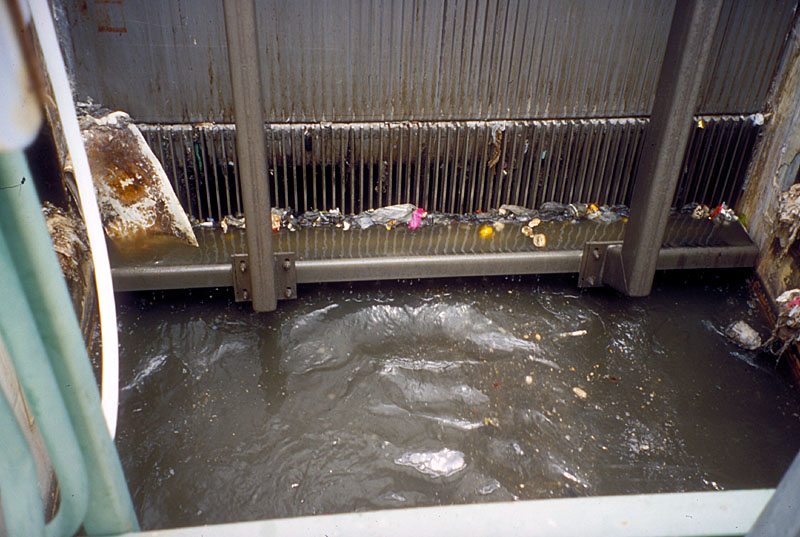
Raw sewage

Raw sewage is 99.9% water. Large objects such as sticks and rags are removed from raw sewage as it passes through bar screens.


Primary clarifier

Next, wastewater is slowed so that settleable organics settle to the bottom while fats, oils, and greases float to the top.


Biological Systems

Biological processes remove most of the rest of the contaminants. Water flows into aeration basins where oxygen is mixed with the water. Microorganisms consume the organic material as food, greatly reducing the BOD in the water. They convert non-settleable solids to settleable solids and are later themselves captured in final clarifiers, ending up in wastewater biosolids. Many operators of WRC's consider themselves "bug farmers", since they are in the business of growing and harvesting a healthy population of microorganisms. Since the process is biological, any chemical or substance harmful to life can interfere with the operation of a water recycling plant. This is why cities prohibit discharges of untreated industrial wastes to sewers and promote education among citizens regarding the harmful effects that dumping household chemicals. When the water recycling plant cannot operate properly because chemicals are killing the microorganisms, water reuse programs are jeopardized and the quality of water discharged to receiving streams is lowered.

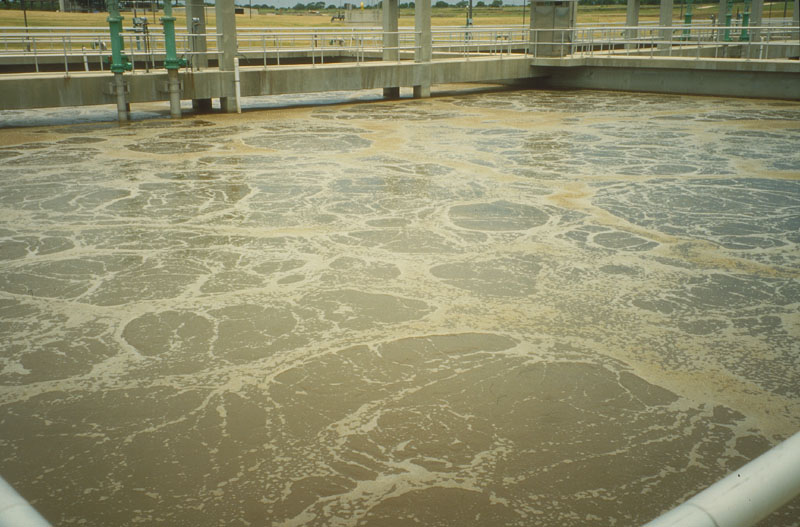
Aeration basin

Air is mixed with the partially treated wastewater so that microorganisms can survive to consume organic material in the water.


Chemical Systems

After the bugs do their work, chemical systems such as chlorine contact chambers are used to kill the remaining microorganisms not captured in final clarifiers. It is not desireable to have residual chlorine in the rivers and lakes, however, so often chlorine is then removed using sulfur dioxide (SO2). This protects the aquatic life in the receiving stream. Using and storing highly toxic chlorine gas poses risks, so many facilities are beginning to use ultraviolet radiation instead of chlorine to provide final disinfection of water. The point where treated water is discharged into a stream or body of water is called the outfall.

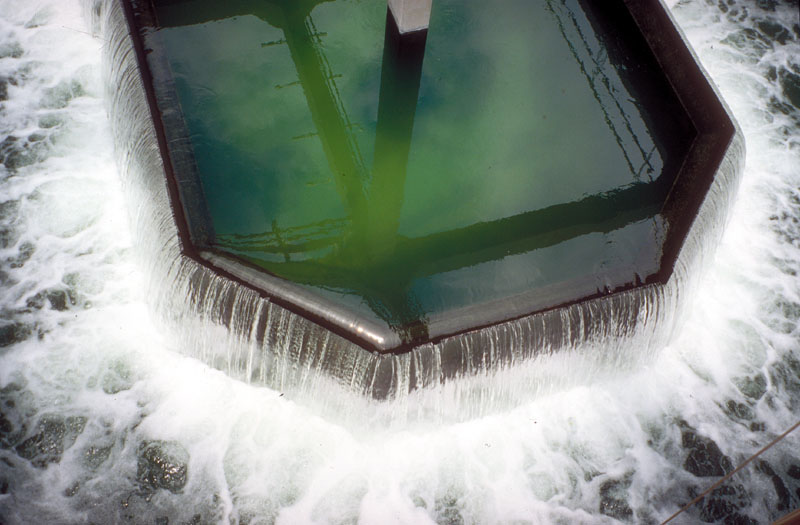
Chlorine contact chamber at Dos Rios Water Recycling Center

This is very high quality water. This tank is 12 feet deep, and note that clarity is excellent all the way to the bottom.


Dos Rios Water Recycling Center outfall

The largest of San Antonio's sewage treatment facilities, the Dos Rios plant produces about 50 million gallons of effluent per day. Imagine a flow of this magnitude discharging from the chasm at San Antonio Springs, and you get an idea of what those springs once looked like!